Why Decks Go Grey
A deck lives in the hardest spot on the house. It takes full sun, rain and snow, plus the weight of every cookout, with nothing to shed the water. Within a few seasons the stain fades, the boards go grey, and the stair treads and rail caps, which see the most traffic, show it first.
Grey boards are not only a colour problem. Once the finish has worn through, water soaks into the wood, the surface roughens, and boards start to cup, split or soften. A deck that was a warm brown in spring can be a splintery grey two summers later, and that is the point where a maintenance job begins to turn into a repair job.
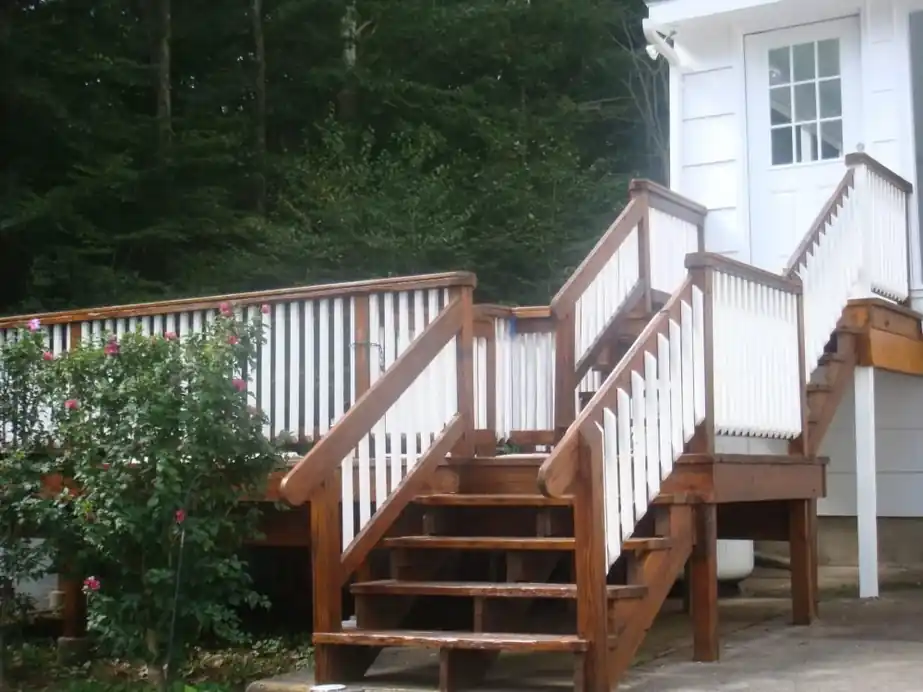
Cloudland's before and after photos of one set of deck stairs show the change: weathered grey treads on one side, and the same stairs stained, with white rails, on the other. The work behind a result like that is not mysterious. Clean the wood, repair what needs repair, and put a finish back on before the boards pay for the delay.
The crew also works on newer decks. A shingled house with a fresh hardwood deck and a built-in planter bench still needs its finish looked after, because a new deck weathers the same way an old one does, only later. Putting a finish on early, before the wood has greyed, is far easier than bringing back boards that already have.
Clean, Repair, Stain
The order matters. A deck is cleaned first, because stain will not hold to dirt, mildew or the grey top layer of weathered wood. Then it is repaired: loose boards, popped fasteners and split rails get fixed before anything covers them. Then it is stained, once the wood has had time to dry.
Along the way the crew looks at the deck the way a careful neighbour would, and flags safety concerns. A railing that moves, a step with a soft spot, a board that gives underfoot: you hear about it. Where the problem is structural, Cloudland refers that work to other contractors instead of pretending a coat of stain solves it.
When the damage is rot or insect damage in deck boards or porch railings, the same contractor can repair it and then restain or repaint it, so the fix and the finish come from one crew. That is the point of keeping a deck on a schedule: catch it while it is a maintenance job and not a rebuild.
Reviewers describe Ray arriving on time and quoting a fair price, and one homeowner wrote that Cloudland did both their exterior and their deck. That pairing makes sense: the stain on the deck should age at the same pace as the paint on the house, and one crew can keep the two in step. It also means whoever is looking at the deck is already looking at the railings and steps, which is where safety concerns tend to turn up.
Around the Garden Beds
Decks sit beside the plants people care about most. The shrubs by the stairs, the perennials along the rail and the beds that run the length of the house all sit in the splash zone of a cleaning and a staining. Cloudland protects landscaping, even when it requires waders.
That phrase says something about how the crew works. When the ground around a deck is low and wet, the plants still get covered properly instead of being left to take the overspray. Floors, furniture and landscaping are covered before work starts, and the crew cleans up when the job is done.
After the stain cures, keep the deck in shape between visits. Sweep leaves and pollen out of the gaps, move planters now and then so the finish ages evenly underneath them, and watch the end grain of the boards and the tops of the rails, where water gets in first.
The estimate is free and written, with no obligation, and it covers the cleaning, the repairs and the stain. It is also the place where anything structural gets named, so you know what Cloudland will handle and what needs another contractor. Better to hear that at the estimate than halfway through a stain job.